The ‘Perfect Storm’: Why the Iran Conflict Could Cause NHS Medicine Shortages Within Weeks
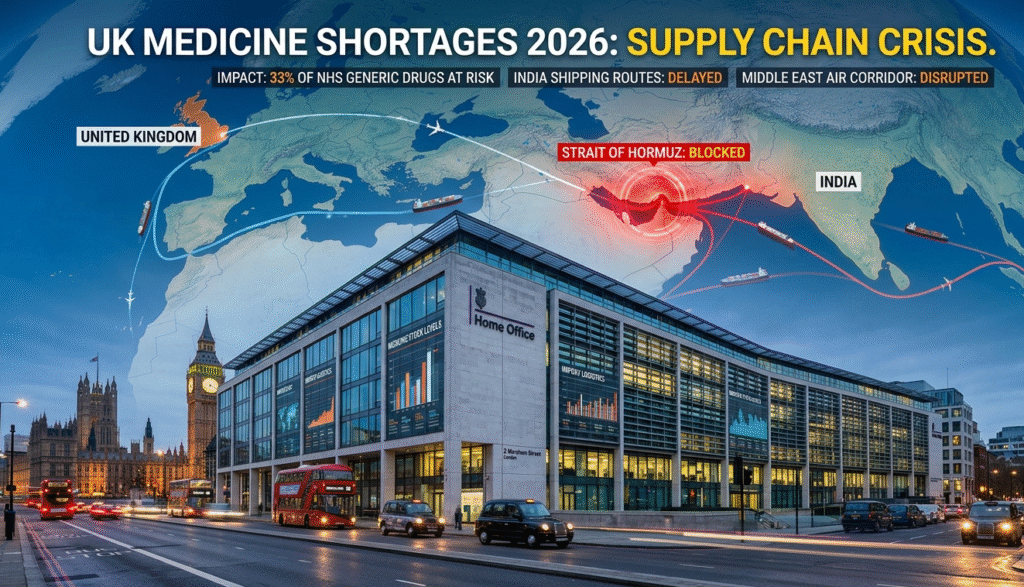
Experts warn the NHS is 'weeks away' from shortages of critical cancer drugs and generic painkillers.
Britain is standing on the precipice of a healthcare supply crisis. Experts are warning that the UK is now just “a few weeks away” from significant shortages of essential medicines, including critical cancer treatments and everyday painkillers, as the ongoing conflict in the Middle East throttles global trade routes.
The disruption has moved beyond oil and gas; it is now hitting the “Pharmacy of the World”—India—which provides a third of all medicines used by the NHS.
🛑 The Logistics Deadlock
The crisis is centered on two major transport bottlenecks: the Strait of Hormuz and Middle Eastern airspace.
- Sea Freight: With the near-total closure of the Strait of Hormuz, ships are being forced to reroute around the Cape of Good Hope. This adds 14 days to journey times and approximately $1m (£750,000) in additional fuel costs per trip.
- Air Freight: Normally, 3,700 passenger flights—which also carry pharmaceutical cargo—transit the region daily. Since the conflict began, air cargo levels have plummeted by 80%, while freight costs have doubled.
💊 Which Medicines are at Risk?
While “stable” generic drugs can be moved by sea, high-priority treatments require the speed of air travel. The following are currently categorized as “disturbed”:
- Life-Saving Treatments: Expensive therapies for cancer and infectious diseases.
- Biologics: Treatments containing living materials that require strict cold-storage “cold chain” logistics.
- Clinical Trial Drugs: Experimental medicines that are time-sensitive.
- General Supplies: Even basic items like syringes, vials, and surgical gowns are seeing price spikes due to the rising cost of petrochemicals (oil and gas) used in their manufacture.
📉 The ‘Six-Week’ Countdown
Mark Samuels, CEO of Medicines UK, notes that while there is no immediate “crisis” today, the buffer is thin.
- UK Domestic Production: Only 25% of medicines are made in Britain.
- Stockpiles: Medical distributors typically hold 6 to 8 weeks of stock.
- The India Factor: India produces 60% of global generic medicines. If the “geopolitical storm” prevents these from leaving Indian ports or airports, the NHS will hit a shortfall by mid-May.
💰 Who Pays the Price?
“In the end, we all pay more,” says Frank Van Gelder of Pharma.Aero. The doubling of air freight costs is currently being absorbed by manufacturers, but with historically low profit margins on generic drugs (which make up 85% of NHS prescriptions), many could become “loss-making.”
The result? While hospital prices are protected by long-term contracts, prices at your local GP practice and community pharmacy are likely to see “single-digit” increases in the coming weeks.